Skip to Content

Author Archives: Energy Machinery, Inc.

  1. What Is a Compressor?

    Comments Off on What Is a Compressor?

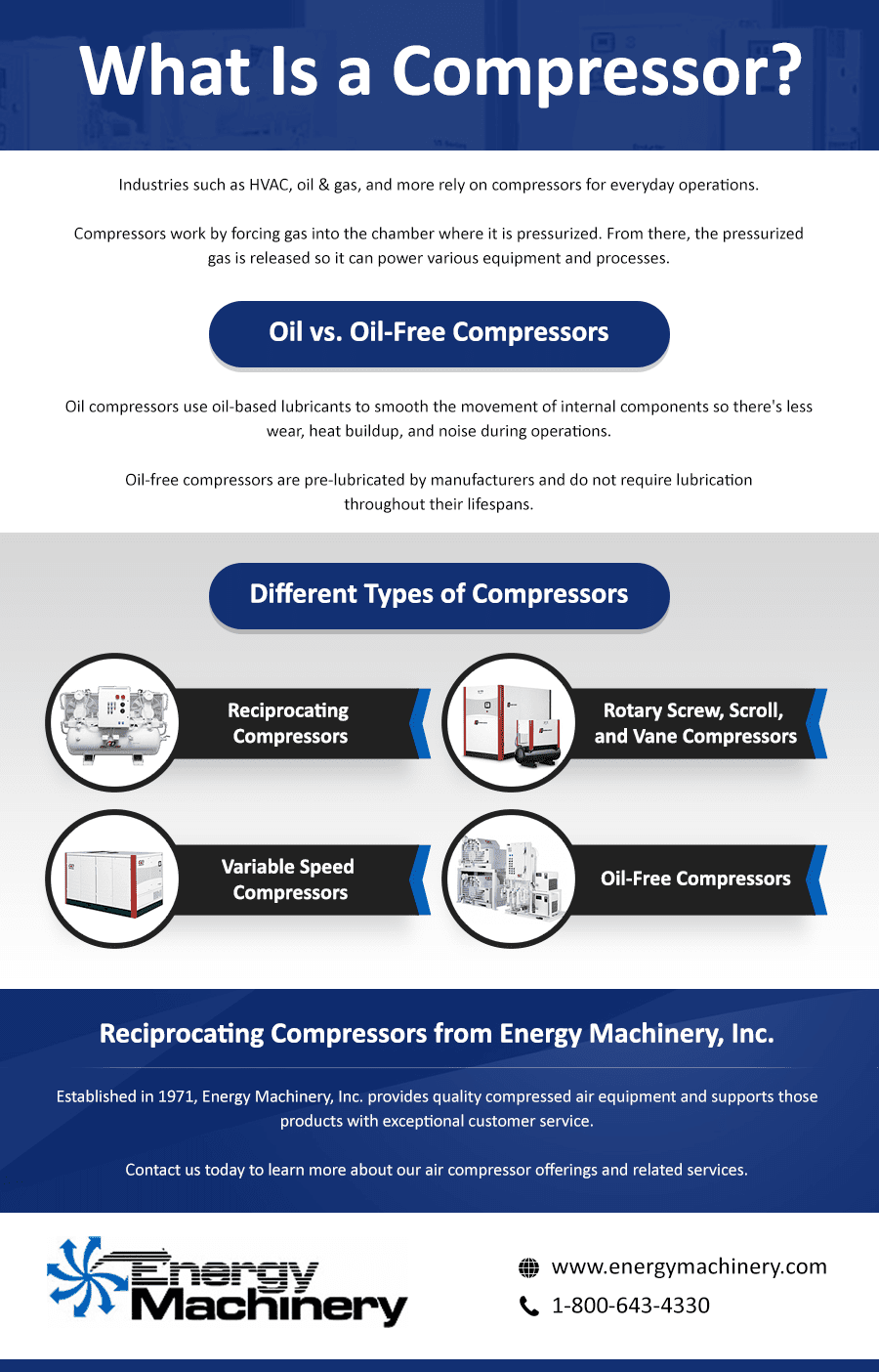
    Many industrial processes rely on compressors to increase the pressure of a gas by reducing its volume. Industries such as HVAC, oil & gas, and more rely on compressors for everyday operations. Compressors work by forcing gas into the chamber where it is pressurized. From there, the pressurized gas is released so it can power various equipment and processes. Here, we will discuss the differences between oil and oil-free compressors as well as the various types of compressors available at Energy Machinery, Inc.

    Oil vs. Oil-Free Compressors

    Oil and oil-free gas compressors both deliver compressed, high-pressure gases that can be used in a wide variety of pneumatic applications. However, there are several key differences between these two categories. Oil compressors use oil-based lubricants to smooth the movement of internal components so there’s less wear, heat buildup, and noise during operations. Oil-free compressors are pre-lubricated by manufacturers and do not require lubrication throughout their lifespans.

    Other important differences include:

    • Maintenance Requirements. Oil compressors require routine maintenance and frequent oil changes, whereas oil-free compressors are maintenance-free.
    • Lifespan. Oil compressors last longer than oil-free alternatives (provided they have proper maintenance). They are more rugged, more durable, and less likely to break down due to wear and heat buildup.
    • Mobility. Oil-free compressors are lighter and more portable, whereas oil compressors are heavier and not as mobile.
    • Price. Oil-free compressors are cheaper per unit than oil compressors. They are also cheaper due to not needing frequent applications of oil lubricant. However, the increased lifespan of oil compressors can lead to overall savings depending on how often the unit is used.

    Different Types of Compressors

    There are many different types of compressors to suit the needs of various industries and applications. At Energy Machinery, Inc., we offer the following compressor types:
    What is a Compressor

    Click to Enlarge

    • Reciprocating Compressors:
      • Reciprocating compressors, or piston compressors, are positive displacement machines that rely on the reciprocating action of two or more pistons to compress gas and deliver it at high pressure. The gas is compressed within a cylinder and discharged through valves into receiving tanks. Common applications for reciprocating compressors include gas transmission pipelines, refineries, and more.
    • Rotary Screw, Scroll, and Vane Compressors:
      • Rotary screw compressors use two meshed rotors to pull in gas. The gas is then compressed as it moves down through the rotors before it is discharged through a discharge port. This type of compressor offers quiet operation compared to reciprocating compressors and is ideal for construction and road building applications.Scroll compressors feature orbiting and stationary spirals which work to decrease the volume of space between them as the orbiting spirals move along the path of the stationary spirals. The gas enters at the outer edge of the scrolls and discharge takes place near the center. This type of compressor is commonly used for home air-conditioning and low-end applications.Vane compressors rely on a series of vanes that rotate from the suction side to the discharge side of an eccentric cavity. As the vanes sweep along the wall, they reduce the volume of space, compressing the gas trapped within. These compressors are commonly used in oil & gas and other process industries.
    • Variable Speed Compressors:
      • These units are rotary screw air compressors with variable speed drives that control the motion of the pieces. This type of compressor is very energy-efficient and can change to meet the needs of fluctuating demands.
    • Oil-Free Compressors:
      • Oil-free compressors do not rely on lubricating oil, making them ideal for applications where contamination is a concern, such as food processing, pharmaceuticals, and more. We offer a range of oil-free compressors, including rotary screw and two stage variable speed centrifugal variations.

    Providing Quality Air Compressors to New England

    Compressors are available in many types to suit the requirements of various industries and applications. Since 1971, Energy Machinery, Inc. has provided high-quality compressed air equipment to our customers. To learn more about our products, or for help selecting the best compressor option for your needs, contact us today.
  2. All About Oil-Free Air Compressors

    Comments Off on All About Oil-Free Air Compressors

    Air compressors take in air and pressurize it, creating clean, compressed air that plays a vital role in industries such as textiles, electronics, food, automotive, and packaging. Air compressors are at most job sites given their varied applications. There are different types of air compressors that you can purchase for industrial use, and they vary in weight, size, output performance, and overall benefits. Knowing the distinctions between oil-free and oil air compressors will help you pick the right type for your project.

    What Is an Oil-Free Air Compressor?

    Click to Expand oil-free air compressors

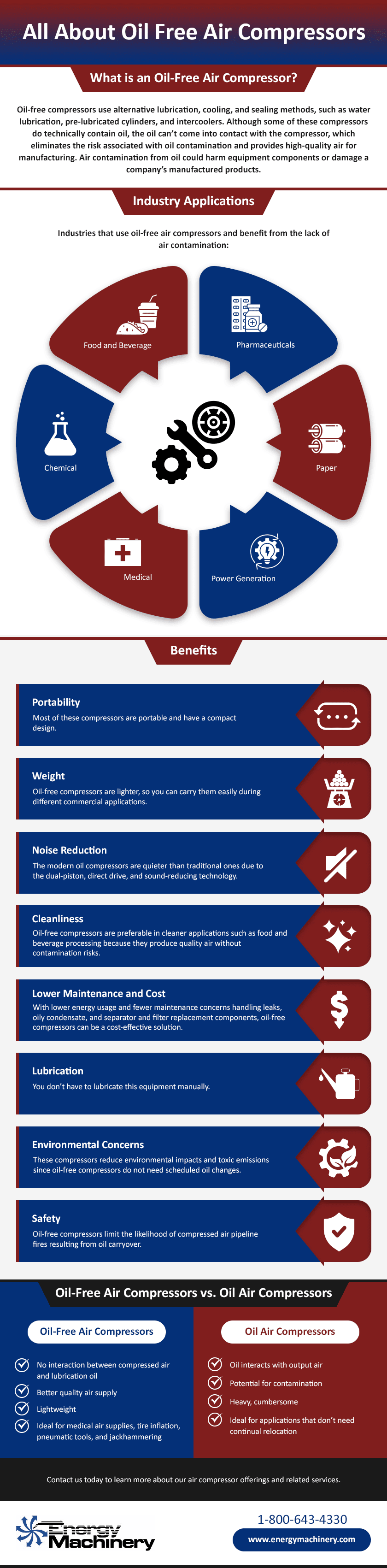
    Oil-free compressors use alternative lubrication, cooling, and sealing methods, such as water lubrication, pre-lubricated cylinders, and intercoolers. Although some of these compressors do technically contain oil, the oil can’t come into contact with the compressor, which eliminates the risk associated with oil contamination and provides high-quality air for manufacturing. Air contamination from oil could harm equipment components or damage a company’s manufactured products.

    Some of the industries that use oil-free air compressors and benefit from the lack of contamination risk include:

    • Pharmaceuticals
    • Paper
    • Power generation
    • Medical
    • Chemical
    • Food and beverage

    Oil-Free Air Compressor Benefits

    The advantages of using oil-free compressors include:

    • Portability. Most of these compressors are portable and have a compact design.
    • Weight. Oil-free compressors are lighter, so you can carry them easily during different commercial applications.
    • Noise reduction. The modern oil compressors are quieter than traditional ones due to the dual-piston, direct drive, and sound-reducing technology.
    • Cleanliness. Oil-free compressors are preferable in cleaner applications such as food and beverage processing because they produce quality air without contamination risks.
    • Lower maintenance and cost. With lower energy usage and fewer maintenance concerns handling leaks, oily condensate, and separator and filter replacement components, oil-free compressors can be a cost-effective solution.
    • Lubrication. You don’t have to lubricate this equipment manually.
    • Environmental concerns. These compressors reduce environmental impacts and toxic emissions since oil-free compressors do not need scheduled oil changes.
    • Safety. Oil-free compressors limit the likelihood of compressed air pipeline fires resulting from oil carryover.

    Oil-Free Air Compressors vs. Oil Air Compressors

    Oil-Free Air Compressors

    One of the most notable features of an oil-free air compressor is the noninteraction between the compressed air and lubrication oil. This results in a better quality air supply, which is valuable in applications such as cleanrooms and dentistry. Also, oil-free compressors weigh much less than oil-lubricated compressors. This makes them ideal for commercial applications in medical air supplies, tire inflation, pneumatic tools, and jackhammering.

    Oil Air Compressors

    In oil-lubricated air compressors, however, the oil running the unit interacts with the output air, potentially introducing contamination. Oil droplets, liquids, mist, and vapors can get into the compressed air. Also, oil air compressors are often mounted as they are heavier and more cumbersome. As a result, they work best in applications that don’t need continual relocation.

    Featured Oil-Free Air Compressors

    Some of the oil-free compressor types available include:

      • PureAir Oil-Less Air Compressors. These compressors have advanced features and meet exacting standards to ensure better air quality. You also enjoy less maintenance and noise as some of the system’s benefits.
      • PureAir II Oil-Less Air Compressors. The PureAir II compressors feature a pressure-based, mounted, oil-less design that is ideal for continuous operation.
      • EnviroAire Series Oil-Free Rotary Screw Compressors. These EnviroAire units are water-injected compressors that operate at a lower temperature, providing low power consumption, high efficiency levels, and near isothermal compression.
      • Ultima Oil-Free Two Stage Variable Speed Compressors. These unique design units have a dry screw air end which provide the ultimate in efficiency.

    Click here to learn more about Gardner Denver’s updated Oil-Free compressor solutions

    Oil-Free Air Compressors From Energy Machinery

    Oil-free compressors are becoming popular in many industries for their various applications and lack of risk for oil contamination. At Energy Machinery, Inc., we have a comprehensive range of oil-free compressors to suit almost any industrial need.

    If you would like to find out more about our line of oil-free compressor solutions, please feel free to view our equipment catalog or contact us today. You can also request information for other products such as reciprocating compressors, variable speed compressors, lubricants and repair parts, used machinery, refrigerated air dryers, and more.

  3. Rotary Screw Air Compressor Guide

    Comments Off on Rotary Screw Air Compressor Guide

    Air compressors are pneumatic devices that increase the pressure of a gas by compressing it into a smaller volume. The kinetic energy contained in the pressurized air can then be used to power various tools and equipment. Based on their method of operation, air compressors can be split into several categories. The most common types include:

    Rotary Screw Air Compressor Guide

    Click to Enlarge

    • Rotary screw
    • Rotary vane
    • Scroll

    What Is a Rotary Screw Air Compressor?

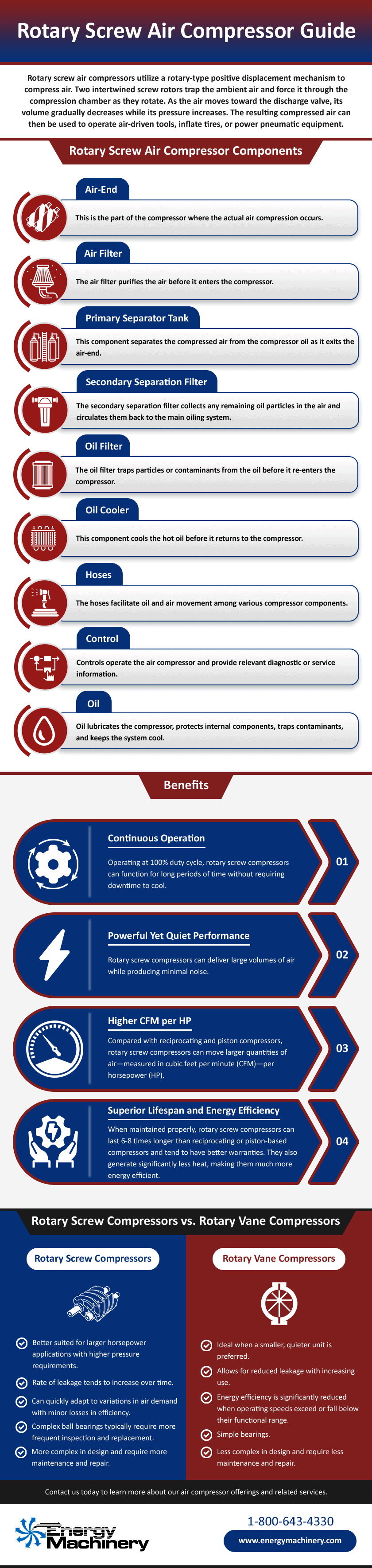
    Rotary screw air compressors utilize a rotary-type positive displacement mechanism to compress air. Two intertwined screw rotors trap the ambient air and force it through the compression chamber as they rotate. As the air moves toward the discharge valve, its volume gradually decreases while its pressure increases. The resulting compressed air can then be used to operate air-driven tools, inflate tires, or power pneumatic equipment.

    The main components of a rotary screw compressor include:

    • Air-end. This is the part of the compressor where the actual air compression occurs.
    • Air filter. The air filter purifies the air before it enters the compressor.
    • Primary separator tank. This component separates the compressed air from the compressor oil as it exits the air-end.
    • Secondary separation filter. The secondary separation filter collects any remaining oil particles in the air and circulates them back to the main oiling system.
    • Oil filter. The oil filter traps particles or contaminants from the oil before it re-enters the compressor
    • Oil cooler. This component cools the hot oil before it returns to the compressor.
    • Hoses. The hoses facilitate oil and air movement among various compressor components.
    • Controls. Controls operate the air compressor and provide relevant diagnostic or service information.
    • Oil. Oil lubricates the compressor, protects internal components, traps contaminants, and keeps the system cool.

    Rotary Screw Air Compressor Benefits

    Rotary screw air compressors provide the following advantages in compressed air applications:

    • Continuous operation. Operating at 100% duty cycle, rotary screw compressors can function for long periods of time without requiring downtime to cool.
    • Powerful yet quiet performance. Rotary screw compressors can deliver large volumes of air while producing minimal noise.
    • Higher CFM per HP. Compared with reciprocating and piston compressors, rotary screw compressors can move larger quantities of air—measured in cubic feet per minute (CFM)—per horsepower (HP).
    • Superior lifespan and energy efficiency. When maintained properly, rotary screw compressors can last 6-8 times longer than reciprocating or piston-based compressors and tend to have better warranties. They also generate significantly less heat, making them much more energy efficient.

    Rotary Screw Compressors Vs. Rotary Vane Compressors

    While they offer similar benefits, rotary screw and rotary vane compressors each have distinct capabilities that influence their suitability for certain applications. These include:

    • Applications. Rotary vane compressors are ideal when a smaller, quieter unit is preferred, while rotary screw compressors are better suited for larger horsepower applications with higher pressure requirements.
    • Leakage & lubrication. While the rate of leakage in rotary screw compressors tends to increase over time, a rotary vane compressor’s design allows for reduced leakage with increasing use.
    • Speed control. The energy efficiency of a rotary vane compressor is significantly reduced when operating speeds exceed or fall below their functional range. In contrast, rotary screw compressors can quickly adapt to variations in air demand with minor losses in efficiency.
    • Bearings. Compared with the simple bearings used in rotary vane compressors, the complex ball bearings of rotary screw compressors typically require more frequent inspection and replacement.
    • Repair & maintenance costs. In general, rotary screw compressors are more complex in design and require more maintenance and repair than their rotary vane counterparts.

    Featured Rotary Screw Air Compressors

    At Energy Machinery, we provide a variety of rotary screw air compressor options to suit specific applications. These include:

    Rotary Screw Air Compressors from Energy Machinery

    Energy Machinery offers an extensive selection of rotary screw air compressors from Gardner Denver and other leading manufacturers. With five decades of experience in our industry, we have the expertise and product selection to meet your specific needs while adhering to your budget.

    To learn more about our rotary screw air compressors or other products, please contact us today.


  4. Silent Air Compressor Buying Guide

    Comments Off on Silent Air Compressor Buying Guide

    Traditional air compressors create a great deal of excessive noise, which can cause various issues such as hearing loss, communication errors, decreased productivity, and more. To prevent these issues, many facilities invest in silent air compressors, which are specifically engineered to emit low levels of noise. The noise dampening properties of silent air compressors helps to decrease mechanical sound and noise pollution while still providing the compressed air needed for your operations.

    Silent Air Compressors Overview

    Click to Expandsilent air compressor buying guide

    Air compressor manufacturers recognize the potential for injury caused by high-volume compressors, which is why they have established standardized ratings based on decibel (dB) levels. The three standard ratings for air compressors are:

    • 40 dB. This compressor rating produces the lowest level of noise. Smaller, low-power air compressors tend to fall within this category.
    • 60 dB. This compressor rating is recognized as the safest noise level for air compressors.
    • 85 dB. Compressors with this rating regularly produce sound that exceeds safe noise levels. Employees who are exposed to this level of sound on a regular basis may experience negative health effects.

    Silent air compressors are specifically designed to create minimal noise through the use of advanced sound-reduction technology. They operate at or below 75 dB. Heavy hardware and noise-dampening materials minimize vibration, and a portable noise-dampening cover further eliminates excess sound. Silent air compressors come in oil-lubricated and oil-free designs, each of which features smooth component motion that reduces excess vibration from friction, grinding, and wear.

    Silent Air Compressors Advantages

    Silent air compressors offer a variety of advantages over more traditional compressor designs, including:

    • Reduced Maintenance
    • Lower Operating Costs
    • Many Applications
    • Extremely Portable
    • Reduced Power Consumption
    • Simple Start-Up
    • Low-Maintenance and Repair Costs
    • Improved Worker Safety

    Silent Air Compressors Applications

    Silent air compressors provide safe, efficient compressed air for a wide range of applications, including:

    • Spray Painting and Coating Equipment
    • Air-Powered and Air Impact Tools
    • Pneumatic Lifts and Elevators
    • Shot Peening and Sandblasting
    • Heating and Cooling Operations
    • Power Cleaning

    Featured Silent Air Compressors

    Energy Machinery, Inc. is pleased to offer a full selection of silent air compressors for use in a variety of domestic, commercial, and industrial applications. All of our ESM 6 compressors are highly efficient, extremely quiet, and cost-effective to operate and maintain.

    ESM 6 – Standard Compressor
    Our ESM 6 Standard Compressor is specifically designed for simplicity and ease of use. This compact 680 mm screw compressor is available with pressures up to 8 bar (115 psig). For those looking for a complete compressor station, we can customize your ESM 6 with tank-mounting and refrigerant dryer plus filter kit options. Installation and maintenance are simple, with removable side doors and quick access to all service points.

    ESM 6 – Mounted on 270 L Receiver
    This ESM 6 compressor is mounted on a 270 L receiver, which increases pressure up to 10 bar (145 psig). Larger than the standard, this model is 1540 mm wide and can be customized with an add-on refrigerant dryer and filter kit. Ideal for moderate commercial and industrial applications, the ESM 6 mounted on 270 L receiver is simple to install and maintain, with easy-to-adjust pressure settings.

    ESM 6 – Mounted on 500 L Receiver
    Our highest capacity ESM 6 design, mounted on 500 L receiver, provides pressures up to 13 bar (190 psig) in a package that is 1950 mm wide. This tank-mounted version can be customized with a refrigerant dryer and filter kit. This design is perfect for larger operations, with ample pressure for commercial and industrial washing, coating, painting, and cleaning operations.

    Silent Air Compressors from Energy Machinery, Inc.

    At Energy Machinery, Inc., we provide superior compressed air equipment for virtually any operation. To learn more about our selection of silent air compressors, contact us today!

  5. Rotary Vane Compressor

    Comments Off on Rotary Vane Compressor

    Rotary Vane Compressor

    An air compressor converts power from electricity, gas, or other sources into potential energy in the form of pressurized air. The pressurized air can be released in a controlled way to provide the kinetic energy needed for its given application.

    In principle, an air compressor’s design is relatively straightforward. Air is brought into a chamber by means of intake valves and thereupon pressurized by a reduction in the chamber’s volume. When energy is needed from the compressor, the pressurized air is released via a discharge valve. 

    There are several types of air compressors available on the market today. There are three common types of air compressors: 

    • Rotary screw
    • Scroll
    • Rotary vane


    This blog post will mainly focus on the design and advantages provided by rotary vane compressors. 

    What is a Rotary Vane Compressor?

    Rotary vane air compressors use centrifugal motion to pressurize the air. They are thus designed quite differently from compressors with reciprocating pistons—instead of utilizing a pumping motion to compress air, rotary vane machines employ a spinning technique.

    How Does a Rotary Vane Compressor Work?

    All rotary vane compressors come equipped with a cylindrical rotor that is off-center from its housing. This rotor contains several partitions—or walls— that extend outwards towards the housing.

    As air is drawn into the housing chamber via intake valves, the rotor spins around in a circular motion. As the rotor spins, its walls squeeze the air trapped between the rotor and the edge of the housing into progressively smaller spaces, which is why the rotor is offset from the center of the housing. This quickly pressurizes the air.

    The now-pressurized air is funneled towards a discharge valve where it may be released and used by a manual operator or automated process. The rotor continues spinning, and the cycle repeats to maintain a steady flow of pressurized air. 

    Advantages of a Rotary Vane Compressor

    There are several advantages provided by rotary vane air compressors, such as:

    • Efficiency. Rotary vane compressors are highly energy-efficient, with their rotors typically spinning at 1,800 rpm or less.
    •  Longevity. Rotary vane compressors are very durable, with some rated for more than 100,000 hours of optimal service.
    •  Flexibility. Rotary vane compressors are extremely versatile, serving a diverse range of industries and applications.

    Rotary Vane Compressors vs. Rotary Screw Compressors

    Rotary vane compressors are often compared to their closest counterpart, the rotary screw compressor. Each compressor has unique advantages and drawbacks. The following is a brief overview of some key differences between the two machines:

    •  Complexity. Rotary vane compressors are fairly simple machines, both in design and in operation. In contrast, rotary screw compressors are much more complex and sensitive, since they include not one major moving part, but two simultaneously active screws that must perfectly match one another’s movements. 
    • Durability. The rotary vane design is much more durable than the rotary screw, featuring 100,000 hours of service life versus 30,000–40,000 hours for the rotary screw design.
    • Power usage. Rotary screw compressors require continuous turns of 3,000–8,000 rpm, versus 1,800 rpm for rotary vane devices. 
    • Maintenance. Generally speaking, rotary vane compressors require more maintenance than rotary screw machines. For example, many rotary vane compressors require an oil change every 2,000 working hours; this interval between servicing is twice as long for rotary screw machines (about 4,000 working hours).

    Rotary Vane Compressors for Sale

    At Energy Machinery, we offer an extensive catalog of rotary vane compressors from Gardner Denver and other major compressor brands. We have provided world-class products and exceptional customer service to customers in a broad range of industries for almost five decades. 

    If you’d like to learn more about our selection of rotary vane compressors or any other products from our catalog, please contact us.

  6. Positive Displacement Blower

    Comments Off on Positive Displacement Blower

    Positive Displacement Blower

    Positive displacement blowers, or rotary blowers, circulate air by pulling a certain volume of gas into the rotary chamber and then pushing it out. Manufacturing and processing facilities use these blowers for a variety of applications, including aeration, vacuum processing, air extraction, and cleaning. 

    There are multiple types of blowers that can provide some degree of air circulation and displacement, including centrifugal blowers and regenerative blowers. However, it’s important to choose the right blower for different applications and energy use requirements.

    How Does a Positive Displacement Blower Work?

    Positive displacement blowers have two rotating impellers inside its central casing. These impellers—which can have two or three lobes—spin in opposite directions to force air into the blower and apply pressure to the air. The air enters the inlet side of the chamber, which is at atmospheric pressure and traps the air between two rotating impellers inside the machine. The blower then pressurizes and discharges the air to create circulation. The positive displacement process ensures that air cannot return to the chamber and that the airflow is unidirectional.

    These blowers have two key advantages:

    1.     They can move large volumes of air.
    2.     The systems are long-lived and straightforward, with relatively few maintenance demands.

    Positive Displacement Blowers vs. Centrifugal Blowers

    Both positive displacement blowers and centrifugal blowers force air movement. Whereas positive displacement blowers use impellers and displacement to force pressurized air through an outlet port, centrifugal blowers use kinetic energy to increase the speed of air moving through the unit. The unit then slows the air through a diffuser to convert the energy into static pressure. Facilities commonly reserve centrifugal blowers for ventilation, continuous gas transfer processes, and aeration applications.

    Regenerative Blowers vs. Positive Displacement Blowers

    Just like with positive displacement blowers, regenerative blowers use rotating impellers to draw air into the unit. Regenerative blowers then use centrifugal forces to accelerate the air and capture it between multiple internal blades. The spinning motion pushes the air from the top to the bottom of the blade configuration. Then, the blower pushes the air out of the unit at high speeds. 

    Regenerative blowers “regenerate” the air by turning it multiple times and increasing the pressure. These blowers are ideal for environments that need to have oil-free air; the spinning parts are self-lubricating and don’t release oils.

    Gardner Denver Positive Displacement Blowers at Energy Machinery

    Choosing the right blower type for a given application is essential. Different blowers work best to provide specific levels of pressure or the desired volume of air. Positive displacement blowers can provide a high degree of air volume movement at low-pressure levels. Energy Machinery provides the following positive displacement blowers:

    • CycloBlower: These positive displacement blowers deliver efficient, high-quality, and durable performance. They have shock-free compression, maintain a high-energy efficiency rating, and deliver oil-free air.
    • DuroFlow: The DuraFlow series of blowers have been used for nearly 50 years. These industrial blowers are durable, have a variety of installation and mounting options, and have multiple subtypes, so you can find the PSI levels that meet your needs.
    • 4500 Series: 4500 Series positive displacement blowers are rugged and can handle a wide variety of industrial applications. Each model comes with at-a-glance features and noise reduction options. 

    Energy Machinery, Inc. has specialized in providing air compression equipment and excellent customer service for over 45 years. We partner with major manufacturers to deliver the units and replacement parts that meet your facility’s requirements. Along with units and parts services, we also offer engineering services such as:

    • Energy audits
    • Leak detection analysis
    • Compressor room analysis, and more.

    Contact our team to learn more about our inventory of high-quality parts and to find the units that will fulfill your facility’s air displacement needs. You can also request a quote to start your order today.

  7. Refrigerated Air Dryers

    Comments Off on Refrigerated Air Dryers

    Refrigerated Air Dryers

    Compressed air can be damaging to applications that require moisture-free air. Atmospheric air that enters an air compressor intake contains water vapor.

    While in the air compressor, heat from compression and pressurization forces water vapor to condense into liquid droplets.

    These droplets travel downstream and can ruin your products, air tools, cylinders, and air motors.

    Refrigerated air dryers take the moisture-laden air from the air compressor discharge and lower the temperature condensing the water vapor to water and separating it from the air before it goes downstream damaging product and equipment.

    How Does a Refrigerated Air Dryer Work?

    Compressed air enters the air dryer at a temperature of around 100F. The air enters an air to air heat exchanger.

    In this heat exchanger, the incoming air is pre-cooled by the outgoing cold air. The air then enters a refrigerant to air heat exchanger which cools the air to around 35F.

    At this lower temperature, the moisture in the air is condensed and separated out of the air and is expelled from the unit.

    Lastly, the air travels through the previously mentioned air to air heat exchanger allowing the incoming warm air to reheat the colder air leaving the air dryer.

    The compressed air leaving the dryer has a pressure dew point between 35°F to 50°F.

    2 Types of Refrigerated Air Dryers

    1. Non-cycling
    2. Cycling

    Non-cycling refrigerated dryers

    Non-cycling refrigerated air dryers operate with the refrigeration compressor running continuously, regardless of the inlet load.

    Minimal energy savings is realized from 100% down to 0% inlet air load.

    Cycling Dryers

    Cycling refrigerated air dryers automatically cycle the refrigeration compressor on and off in response to inlet load conditions as the inlet air load is reduced the refrigeration compressor cycles off, providing energy savings.

    This is done through some type of thermal mass that holds the temperature once the air compressor cycles off.

    Contact Us for Your Application

    Need help deciding on the best one for your application? Contact us today and a product expert will get back to you immediately!

  8. Variable Speed Compressors

    Comments Off on Variable Speed Compressors

    Variable Speed Compressors

    Rotary screw air compressors controlled by VSDs (variable speed drives) are one of the best energy efficient industrial innovation introduced in the past few years.

    The style of air compressor control can reduce energy wasted by compressors running in the unloaded condition exponentially.

    Variable speed air compressors are ideal for plants that have fluctuating demand.

    Some examples of this demand include Single shift seasonal type businesses that have higher production levels for a couple of months out of the year, or 24/7 operations, that have varying demands between shifts.

    Variable Speed Air Compressor Benefits

    • Reduced energy consumption
    • Quieter than a fixed speed when running at a lower RPM
    • Consistent plant pressure increased component lifetime
    • Low inrush current during motor starts
    • May qualify for energy incentives

    Single State vs. Two Stage Variable Speed Air Compressors

    The main difference between single and two-stage air compressors are the number of compression stages.

    Single stage air compressors compress air from atmospheric pressure to operating pressure in one stage.

    A two-stage compressor uses two stages to compress the air.

    The first-stage compresses the air to around 30 psig after which it is cooled before entering the second stage.

    In the second stage, the air is compressed from 30 psig to operating pressure usually around 100 or 125 psig. This allows for the compressor to reach operating pressure more efficient

    Example:

    • 100 horsepower single stage delivers 436 CFM @ 125 psig
    • 100 horsepower two-stage delivers 513 CFM @ 125 psig

    Variable Speed Compressors at Energy Machinery

    At Energy Machinery, we offer 24-hour field service and certified technicians are available with for troubleshooting and repairs, turnkey instructions, and planned maintenance programs.

    We are an authorized warranty repair center for Gardner Denver, Champion, and Cooper Cameron compressors.

    Take a look at our variable speed air compressors below. If you need help finding the right one for your business, contact us today and a representative will reach out to you quickly!

  9. Benefits of Oil Free Air Compressors

    Comments Off on Benefits of Oil Free Air Compressors

    Benefits of Oil Free Air Compressors

    Air compressors, like many other types of mechanical equipment, require adequate lubrication to ensure maximum longevity and optimum performance. The piston, in particular, needs to be able to draw and compress air with minimum frictional resistance. In this regard, air compressors are available in two primary configurations: oil vs oil free air compressor systems.

    In oil-lubricated compressors, oil is used to reduce the friction between the piston and the walls of the piston chamber. Oil may even be splashed onto the walls and bearings of the cylinder by means of an oil bath. This type of compressor is also referred to as oil-flooded.

    On the other hand, oil-free compressors, as their name suggests, do not require lubrication oil. Instead, the piston is pre-lubricated with a Teflon (PTFE) coating. Teflon has one of the lowest coefficients of friction among any solid due to its layered structure, which possesses relatively weak intermolecular bonding forces. These layers easily slide past each other with minimal effort, significantly reducing the friction between the coated elements.

    While many compressors in use today are oil-lubricated, oil-free compressors are quickly gaining popularity among various industries. Oil-free compressors are less expensive and capable of achieving the same level of performance as their oil-lubricated counterparts in most applications, making them ideal for myriad industrial purposes.

    However in the case of oil vs oil free air compressor machines, which one does your business need?

    Oil Vs Oil Free Air Compressor: Which One Is Best for You?

    One of the defining features of oil-free compressors is the absence of interaction between the lubricating oil and the compressed air. In oil-lubricated compressors, the air inevitably comes into contact with the oil, introducing a degree of contamination.

    Oil droplets, vapors, mist, or liquids can make their way into the output compressed air. This problem is eliminated in oil-free compressors, leading to a better quality compressed air supply. This is especially valuable in applications where air quality is paramount, such as in dentistry or cleanroom compressors.

    Oil-free compressors are also significantly lighter than oil-lubricated compressors, making them ideal for commercial applications that require portability, such as tire inflation, jackhammering, medical air supplies, and roadside assistance pneumatic tools.

    Oiled compressors, on the other hand, are bulkier, heavier, and often require mounting. This makes them better suited for situations where the equipment does not require frequent relocation.

    How to Maintain an Oil-Free Air Compressor

    Oil-free compressors are especially renowned for their minimal maintenance requirements. The absence of lubricating oil combined with the self-lubricating nature of the Teflon coating means that the cylinder requires no further lubrication, eliminating the need for scheduled oil changes.

    However, oil-free does not translate to maintenance-free. These pumps must still undergo routine maintenance to ensure safe and efficient compressor operation and optimal service life. Oil-free air compressor maintenance usually consists of checking the following components:

    Safety valve

    When inspecting the compressor safety valve, first ensure that the compressor is plugged in and allowed to reach its shut-off pressure. Next, remove the safety valve ring to release the pressure from the tank and observe the valve. If the air is not discharged, or if the valve does not close automatically, then the valve may need to be replaced.

    Compressor tank

    Condensation can cause water droplets to build up inside the tank. Ensure that that tank is adequately drained after each use by locating the drain valve and allowing the tank to drain completely.

    Air filter

    Be sure to inspect the filter for dirt build-up and wear. Depending on the compressor model, the location, and type of filter (paper, felt, or foam) may vary. Paper or felt filters with significant contamination buildup need to be replaced. Foam filters can be cleaned with soap and water and replaced upon drying. All damaged or worn filters should be replaced immediately.

    Additionally, an overall inspection of the compressor should be routinely conducted. Inspect various components such as hoses, valves, power cords, fittings, and seals for damage and signs of wear. The tank’s exterior should also be checked for rust damage, pinholes, or other weak spots. It is important to note that damaged tanks should be replaced immediately. Never attempt to weld, drill, or otherwise repair the compressor tank.

    At Energy Machinery, we offer a comprehensive range of oil-free compressors for almost any industrial application. If you would like to find out more about our line of oil-free compressor solutions, feel free to view our equipment catalog or request a free quote today.

  10. What is a Reciprocating Compressor?

    Comments Off on What is a Reciprocating Compressor?

    Compressors are mechanical devices used to intentionally increase the pressure of a air. They work by “squeezing” the air into a smaller volume, thereby causing a buildup of stored potential energy to be used when needed. Although there are many types of compressors, most of them generally fall under two classifications: dynamic and positive displacement.

    Reciprocating compressors belong to the category of positive displacement compressors. These type of compressors operate by drawing fluid into a fixed-volume chamber via a mechanical component which physically displaces the air. Other types of positive displacement compressors include rolling piston, rotary screw, rotary vane, and diaphragm compressors.

    Reciprocating Air Compressors

    Reciprocating air compressors consist of a piston driven by a crankshaft enclosed within a cylinder. The typical reciprocating air compressor is also comprised of suction and discharge valves.

    Compression is accomplished via a cycle of operations. First, the piston receives power from the main shaft via a rotating crankshaft. During the piston’s suction stroke, the volume within the cylinder increases while its pressure decreases. This allows the relatively higher pressure external air to open the inlet and enter the cylindrical chamber.

    On the piston’s compression stroke, the volume within the cylinder decreases, raising the pressure of the collected air. This increase in pressure opens the outlet valve, causing compressed high-pressure air to flow out of the cylinder into a storage tank.

    Reciprocating air compressors differ from other types of compressing mechanisms in that the flow is highly controlled. The volumetric flow rate is simply the volume of the cylindrical chamber multiplied by the piston stroke rate. In other words, the throughput of a reciprocating compressor is solely dependent on the displacement mechanism (the piston, shaft, and crankshaft). This characteristic is extremely beneficial from an automation and control standpoint.

    Common Questions About Reciprocating Compressors

    Can a reciprocating compressor run backward?

    Generally, if the direction of a reciprocating compressor is reversed, there will be no adverse effect on the compressibility factor and air discharge/suction capacity. Lubrication, however, may become an issue. For splash-lubricated pumps, positive pressure will simply be generated at the inlet filter while a vacuum will be created at the discharge.

    Can you replace a reciprocating compressor with a scroll?

    A scroll compressor, also known as a scroll pump, uses two interweaving spiral-shaped vanes to compress and pressurize fluids. One scroll remains fixed, while the other orbits within it in an eccentric manner, trapping and compressing pockets of fluid between the scrolls. Generally, scroll and reciprocating compressors are interchangeable. However, specific tubing, mounting, and other modifications will need to be done by a professional.

    Which compressor is better? Rotary or reciprocating?

    In terms of compression efficiency, reciprocating compressors are marginally more efficient than rotary compressors. For the same amount of air, a reciprocating pump can use 5% to 10% less energy than its rotary counterpart. On the downside, reciprocating pumps can be more expensive and require more maintenance.

    Reciprocating Compressors from Energy Machinery

    Reciprocating compressors are simple, yet highly efficient devices. They can be found in several industries, including manufacturing, food production, agriculture, pharmaceutical, and construction.

    At Energy Machinery, we provide a wide variety of reciprocating compressors for a broad range of applications. If you would like to learn more about our compressor equipment, request a quote from us today!

Partners

About Us

Established in 1971, Energy Machinery, Inc. provides quality compressed air equipment and supports those products with exceptional customer service.

50+ years In business

50+ years In business

Distributor deals with over 20 major manufacturers

Distributor deals with over 20 major manufacturers

24 hour field service from certified technicians

24 hour field service from certified technicians

Learn More About Us
^